top of page

Supporting
the stillbirth journey
Why?
In 2022, more than 3,000 stillbirths were recorded across Canada, including 567 in British Columbia. A third of which took place at BC Women’s Hospital + Health Centre. Yet, stillbirth doesn’t have a unique journey. It has been disregarded, and because of its profoundly sensitive nature, surrounded by grief, it is a taboo that needs careful attention.
How can we identify the core needs of people who have experienced a stillbirth, to improve the in-hospital journey?
How? A 3-phase plan.

What tools do we need?
How do we co-design the future of the stillbirth journey in caring and safe ways for bereaved parents?
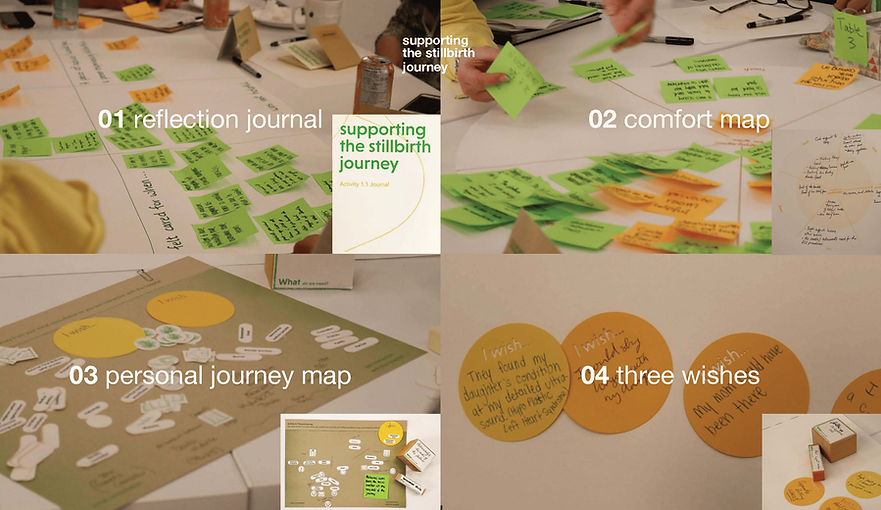
In smaller groups, we paired designers and clinicians to facilitate co-design sessions.
We engaged participants with cautiously made tools, using grounding earth tones and textures. We offered spaces to retrieve physically and mentally by creating two-step activities. We began with personal reflection, followed by group engagement. Allowing participants to decide whether to share or not.
We thanked each participant with a hand-signed card that included a QR code linking to a digital resource list and flower seeds to attract hummingbirds, a symbol in the stillbirth community.
Then? What should we do?

Using a reflexive thematic analysis method, both designers and clinicians analyzed the workshop findings. It led us to four main themes, triggering short and long-term changes in the care journey.
Acknowledgement:
A big thank you to the Health Design Lab team, BC Women's Hospital team, and our participants.
Learn more here:
In the BC Medical Journal. Supporting the stillbirth journey at BC Women’s Hospital and Health Centre.
For the Design4Health Conference. Supporting the stillbirth journey: a comparison of in-person and virtual co-design workshop approaches to gathering knowledge from bereaved parents about their hospital experience.
bottom of page